PAWEŁ KOPACZEWSKI 20.06–7.07.2026.
PLAYTIME
The concept of “playtime” suggests play as a social practice embedded in the structures of everyday life. Paradoxically, however, rather than allowing for spontaneity, these structures organize and regulate it in a systematic way, reducing free engagement to a “game of action”—ordered, yet devoid of full agency.
The title of Paweł Kopaczewski’s exhibition draws inspiration from Jacques Tati’s film Playtime (1967)—an abstract comedy composed of sequences depicting a dehumanized vision of a modern city, where people are thrust into a world of machines and anonymous crowds. This dystopian city functions as a space subject to a standardized, modernist aesthetic. The actions performed by the characters stem directly from the situations in which they find themselves, and they themselves give the impression of being deprived of any real ability to influence their own lives. The focus is not on dialogue, but on the mechanical nature of actions and the sounds of the city and its people. This intensifies the sense of human alienation in the city, but also draws attention to the individual’s participation in the “game” of everyday life, where they become increasingly distanced from themselves and others.
In his practice, the artist interprets this concept as an interval of seemingly autonomous action, in which the structure of play is completely absorbed by the logic of production, and the participant loses the ability to grasp the moment of transition from play to work. Treating the concept of playtime as the opposite of work and a kind of enclave of freedom within the system is a naive assumption. For leisure time does not become a space of rebellion; on the contrary—within it, people reproduce their own submissiveness, maintaining only the appearance of making independent choices.
In this context, everyday objects, though devoid of grandeur, begin to function as a closed system. They encircle people like an ever-expanding “playground,” composed of everything created by human hands and constituting a material trace of human ideas. These objects give meaning to other, seemingly similar things, while simultaneously affirming the status of human existence. Through this excess, humans become increasingly lost in the reality that surrounds them. Thrown into a daily life filled with ever-newer objects, they fall into the absurdity of a reality no longer created for humans, but one that is increasingly taking place at their expense.
The series of paintings featuring skulls proposes interpreting the plastic skull as an object that moves between various orders of cultural and consumerist meanings. The skull does not serve as a classic vanitas motif, reminding us of the transience of life, the inevitability of death, and the futility of worldly goods. Rather, it confirms that the symbol has been completely absorbed by the language of decoration and commodities, losing its ability to provoke reflection on transience. Playing with a symbol marked by strong vanitas connotations generates tension at the level of form: between vitality and death, between the trivial and the irreversible.
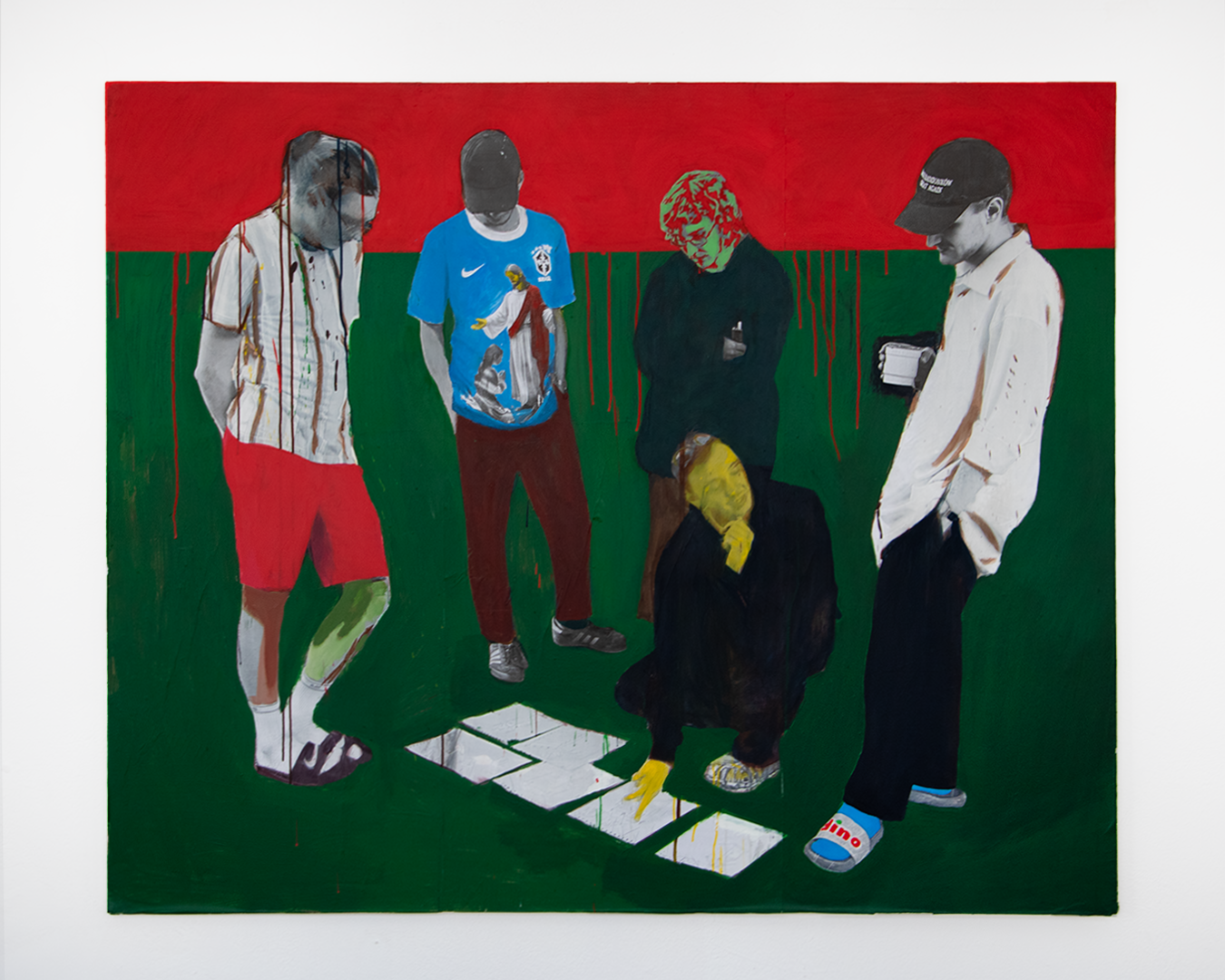
Jacques Tati’s Playtime becomes a point of reference for reflections on community, which recurs in Paweł Kopaczewski’s works both as a theme and as a creative method. Collective action defines the essence of the creative process. Here, collectivity does not guarantee meaning or purpose, but rather suspends them, making the act of collective action itself an autonomous value, independent of the outcome.
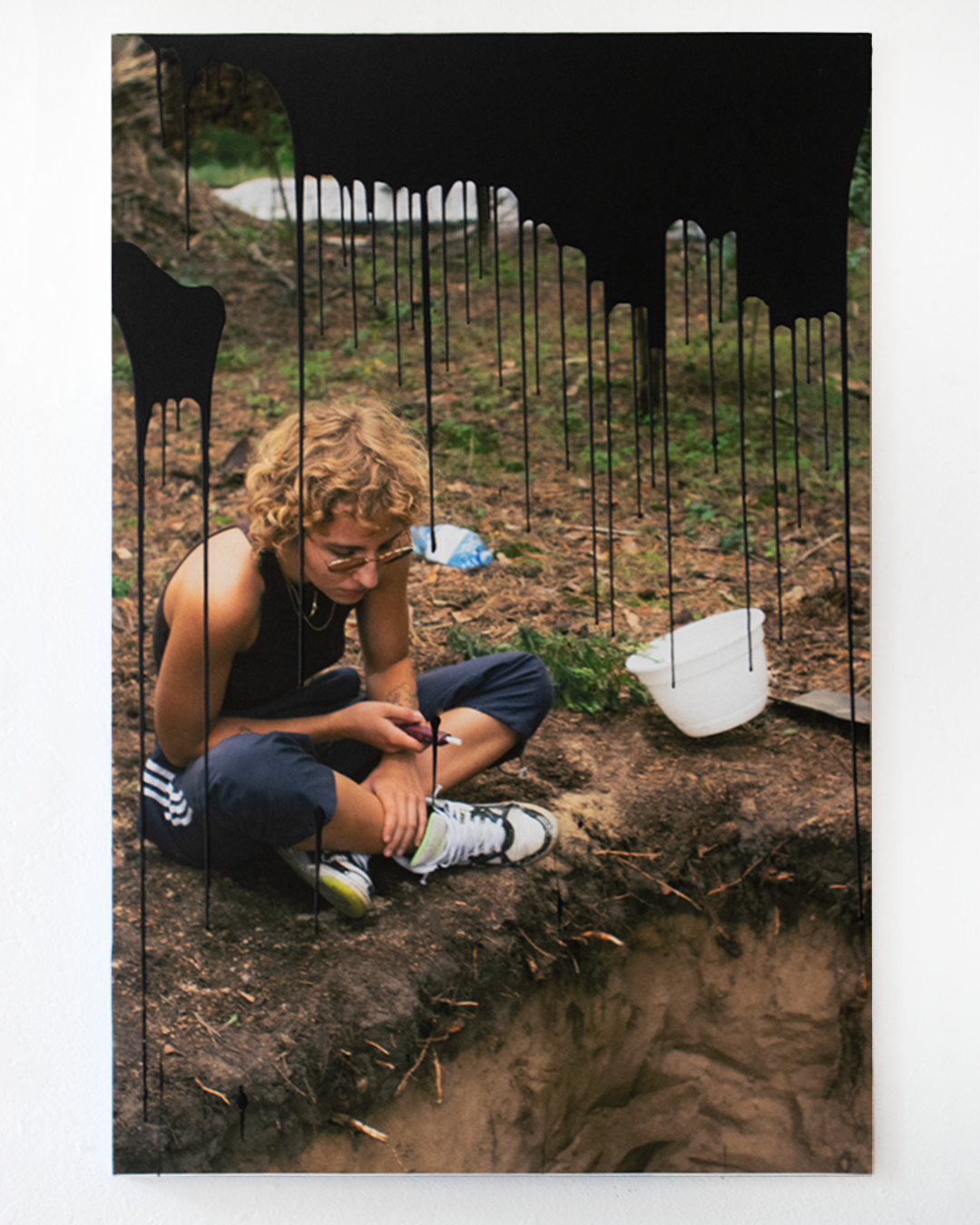
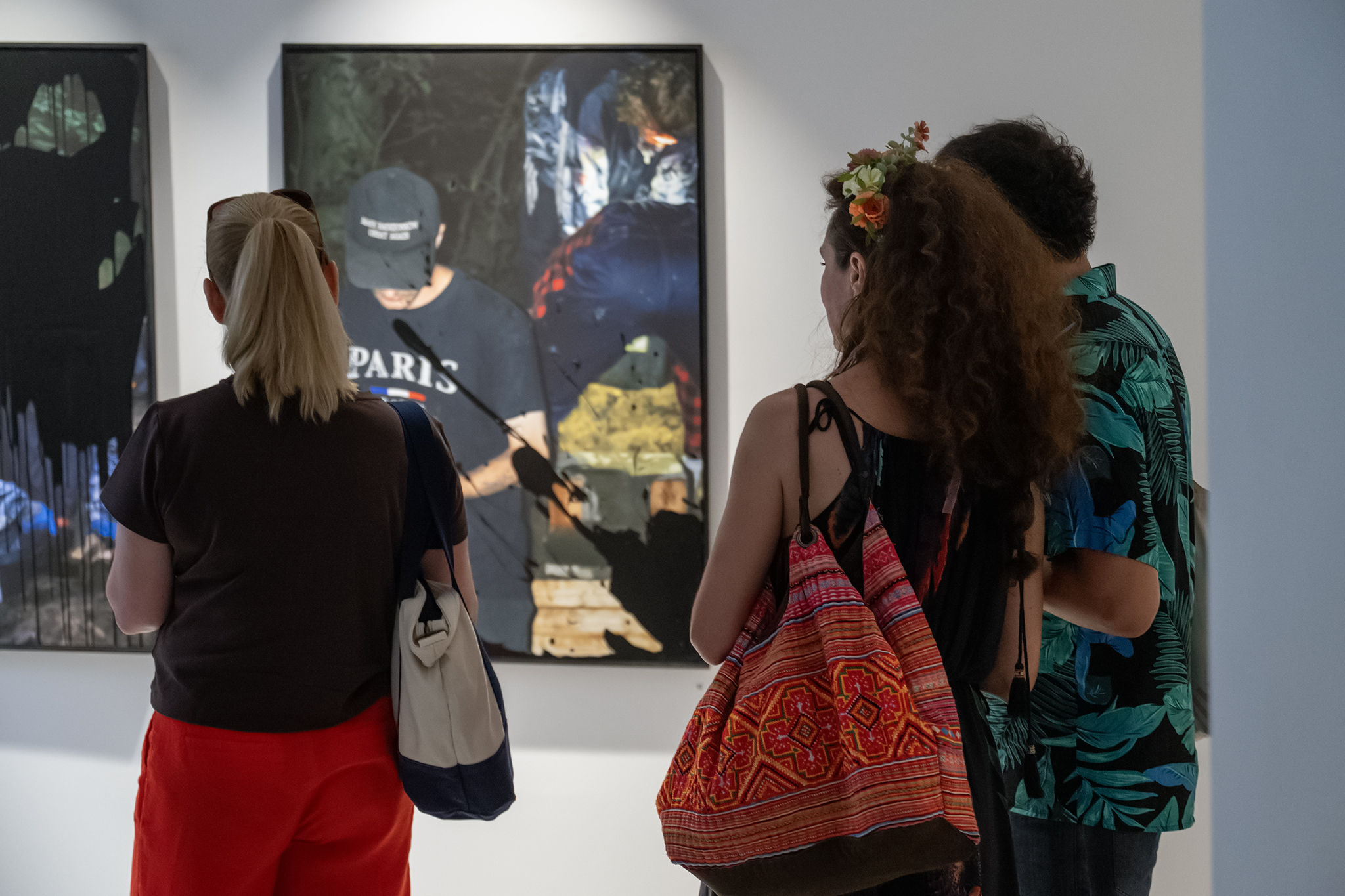
The artist’s painterly journey neither begins nor ends with painting itself. The medium of painting becomes a tool for building tension between the image, the representation, and the impulse that gave rise to it. A painting can be understood as a kind of mental shorthand that unfolds and is completed in the process of reception. Paweł’s paintings incorporate gray paper, photographic prints, markers, and acrylic paints. The works take the form of collages that are formally cohesive despite the heterogeneity of their components. They can be interpreted in relation to Kantor’s “object of the lowest rank,” suggesting that the path to an idea leads through what is ordinary, worn-out, and bearing the traces of human existence—in opposition to decorativeness, which shifts the emphasis to aesthetics and obscures the purpose.
The exhibition is complemented by an annex—a monumental structure containing sketched fragments of building views from the artist’s hometown. It takes the form of a spatial installation composed of architectural segments, stacked in defiance of logic. Fragments of tenement houses, skyscrapers, apartment blocks, and ornaments together form a Tower of Babel: an eclectic accumulation, a structure expanding beyond scale and beyond any purpose. The black-and-white, sketch-like quality of the layered canvases, punctuated by painterly interventions, strips the city of its spatial concreteness, leaving only a representation. What remains is a dystopian vision—a structure that promises habitation yet, by its very logic, renders it impossible.
The same logic carries over to the social level, where the individual functions within a system based on repetition, movement, and the illusion of meaning. A society conditioned to function in a specific way does not rebel against its role, much less reflect on its meaning. It submits to the slow erosion of individuality in favor of a world operating according to social rules. It sacrifices originality of thought in favor of adopting ideas that never fully become its own, believing that being part of the structure is freedom.
This presents a vision of a postmodern society operating within a space subordinated to the (il)logic of a game, based on repetitions and ceaseless movement that offers no guarantee of a specific goal. This logic of the ceaseless expansion of structures is also explored within the exhibition space.
An essential theoretical point of reference for the series remains Andrei Platonov’s The Pit, a story about people digging the foundation for a building that will never be built. Collective action becomes an end in itself, though deeply conditioned by systemic reality. The truth lies somewhere between the human being and the idea. Humans, limited by their own bodies and minds, often relinquish their agency just to become part of something greater. The sacrifice of creative energy for an impossible project that will never come to fruition maintains a state of tension with regard to hope.
The living want to be dead when they feel their bodies can no longer fulfill their greater potential. The dead, in turn, determine the extent of sacrifice for society. Death is treated as a human act—unburdened by emotional impulse. The line between death and life, purpose and desire, understanding and acceptance of facts, becomes blurred.
“He was given a shovel, and with the bitterness of despair over his own life, he clenched it in his hands, as if he wanted to extract the truth from the earth’s dust; yet, through the misery of his hours and the meaninglessness of his existence, he longed at least to see it embodied in another human being—and to be near that person, he was willing to devote his entire frail body, composed of thought and meaninglessness, to the task.”
– Andrei Platonov, The Pit.
Apolonia Grądek
Advisor: Prof. Andrzej Rysiński (main thesis), Dr. Piotr Wachowski (supplement)
Text and curatorial supervision: Apolonia Grądek